What is Power BI?
Power BI is Microsoft’s enterprise business intelligence platform that connects to multiple data sources, transforms raw data into structured models, and visualizes insights through interactive dashboards and reports. It works by integrating data, applying analytics, and delivering real-time business intelligence across the organization. Unlock the full potential of enterprise analytics while realizing measurable Power BI benefits, including improved forecasting, efficiency, and governance.
How limited visibility holds back performance
Even with a modern ERP in place, fragmented reporting and inconsistent analytics create measurable financial and governance risk:

Finance teams rely on manual consolidation across ERP, CRM, and operational systems

KPIs vary by region and business unit, limiting executive alignment

Decision-makers depend on delayed or static reports

Reporting environments lack centralized governance and audit control

What begins as reporting inefficiency quickly escalates into slower forecasting, working capital blind spots, margin erosion, and strategic delay. Layering dashboards onto siloed data does not create enterprise intelligence. It increases complexity and keeps leadership reactive instead of performance driven.
This is where an enterprise-grade analytics platform becomes critical. Built on Microsoft Power BI and integrated across Microsoft Dynamics 365 and Microsoft Azure, Power BI transforms governed data into real-time, AI-powered insight, delivering standardized KPIs, predictive forecasting, and a secure single source of truth across the enterprise.
Why limited visibility holds back performance
Organizations today face challenges in turning data into actionable insights:

Teams struggle to consolidate data from multiple systems

Manual reporting slows down decision-making

Forecasting and predictive insights are limited or inaccurate

Collaboration on insights across departments is difficult

Compliance and audit processes are cumbersome

These inefficiencies can lead to missed revenue opportunities, operational delays, and poor strategic decisions. Point solutions or spreadsheets often increase complexity instead of simplifying it.
How Microsoft Power BI platform transforms operations
Power BI platform connects data, processes, and people across the organization into one governed analytics ecosystem.
Leveraging Azure’s cloud architecture, Power BI:
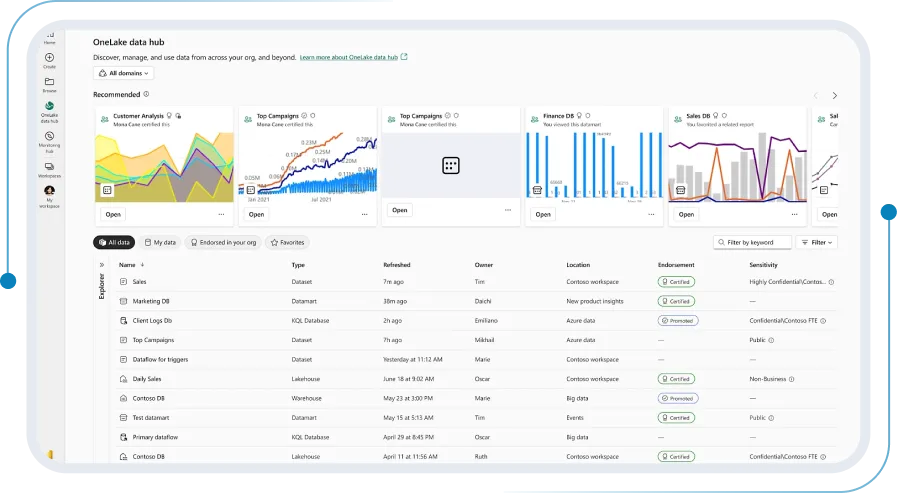
Integrates data across cloud and on-premises systems
Automates data refresh, validation, and modeling
Applies AI-driven analytics and forecasting
Delivers role-based dashboards across leadership tiers
Enforces enterprise-grade security and compliance controls
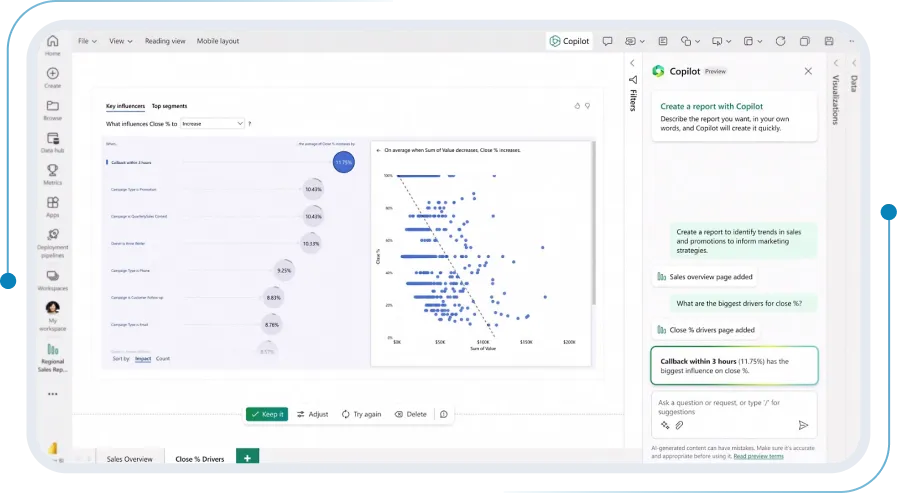
With embedded AI and Copilot functionality, executives can use natural language to query data, surface anomalies, and generate automated insights in seconds.
The result is a connected enterprise operating with real-time visibility, predictive foresight, and structured governance.
Core capabilities and business outcomes
Enterprise data integration
Strategic unification of enterprise data across systems and geographies.
Capabilities:
500+ native data connectors, real-time and scheduled refresh, hybrid cloud, on-premises integration and API extensibility
Business Outcomes:
- 360° enterprise visibility
- Up to 40% reduction in reporting preparation time
- Elimination of siloed data sources
- Improved cross-functional collaboration
Executive dashboards and real-time reporting
Leadership-grade visibility into financial and operational KPIs.
Capabilities:
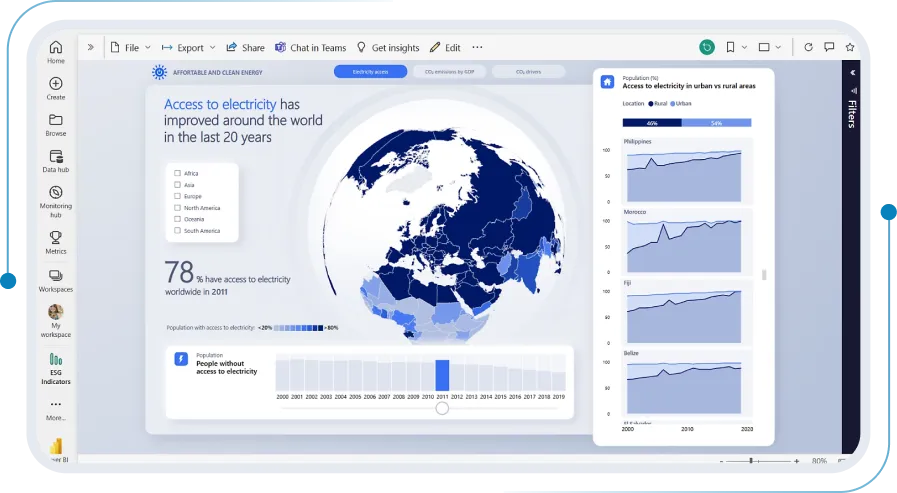
Interactive dashboards, drill-down analytics, role-based access and secure mobile access
Business Outcomes:
- Faster executive decision cycles
- Improved working capital oversight
- Enhanced KPI accountability
- Greater operational agility
AI-driven insights and predictive analytics
From descriptive reporting to predictive intelligence.
Capabilities:
Built-in AI visuals, natural language queries, anomaly detection, forecasting and trend analysis
Business Outcomes:
- Early risk identification
- Improved forecast accuracy
- Better demand and supply planning
- Data-backed strategic planning
Governance, security, and compliance
Enterprise control embedded into analytics.
Capabilities:
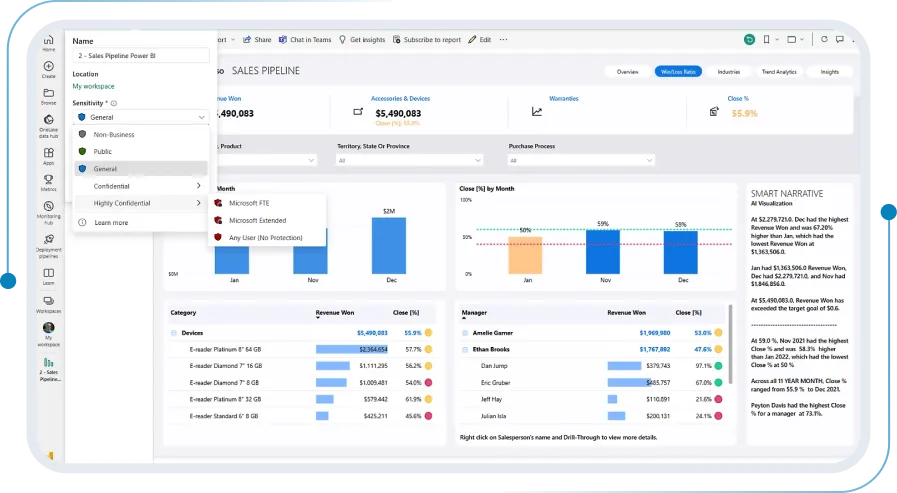
Role-level security, data lineage visibility, sensitivity labelling and integration with Microsoft Purview
Outcomes:
- Reduced compliance risk
- Audit-ready reporting
- Controlled global data access
- Strengthened corporate governance
Power BI components: Desktop, service, mobile, and embedded
Power BI platform operates as a modular, scalable enterprise business intelligence platform:

Power BI
Desktop
Data modeling and report creation

Power BI
Service
Cloud-based publishing and collaboration

Power BI
Mobile
Secure mobile
access

Power BI
Embedded
Analytics within enterprise applications

This flexibility makes Power BI ideal for global enterprises seeking a governed, scalable enterprise business intelligence platform.
Key Power BI platform benefits for enterprise organizations

Real-time visibility
Executives gain instant insight into enterprise performance across entities and regions.

Predictable performance
AI-driven forecasting supports proactive financial and operational planning.

Automation and efficiency
Automated data refresh and reporting reduce manual effort and reallocate finance resources to strategic initiatives.

Governance and compliance
Centralized controls reduce regulatory exposure and strengthen internal oversight.

Scalability
Cloud-native infrastructure supports expansion, acquisitions, and global operations.

Lower total cost of ownership
Reduced reliance on legacy BI systems and manual processes lowers long-term operational and technology costs.

Client success stories at sa.global
Datascrip: Transforming reporting and insights
Challenge: Manual reporting limited Datascrip’s ability to make timely, informed decisions.
Solution: Partnering with sa.global, Datascrip implemented Microsoft Power BI and Azure, centralizing reporting and automating analytics across operations.
Outcomes:
- Automated reporting freed finance and management teams from manual spreadsheets
- Real-time dashboards improved operational transparency
- Faster insights empowered executives to make informed decisions
Power BI platform enabled Datascrip to shift from manual reporting to automated, visual analytics, improving decision speed, transparency, and efficiency.
Licensing and investment overview
Power BI platform licensing is structured for flexibility and scale:
- Per-user licensing (Pro)
- Premium per user
- Premium capacity for enterprise deployment
Investment levels vary based on data complexity, governance requirements, user volume, and integration scope.
A strategic assessment ensures alignment between the licensing model and business objectives.
Three months into the implementation and our accounting team is pleased with the efficiency, outcomes, and potential of this interconnected platform. Business Central will save us time, make us efficient, and eventually give us reporting through Power BI. I believe that this tool will give visibility to all and help Chillibreeze measure the value creation; and that is the pathway to growth.
Joanna Budelman,
Co-Founder
Chillibreeze Solutions Pvt Ltd
Why partner with sa.global?
sa.global is an 11-time Microsoft Partner of the Year and a member of Microsoft’s Inner Circle, a recognition reserved for top-performing global partners.
Our differentiation:

Global delivery capability across 80+ countries

Deep industry specialization

CFO-aligned transformation expertise

Proven enterprise governance frameworks

Outcome-focused methodologies with measurable business value

Post-go-live managed services and optimization
By understanding how Power BI platform works, leadership teams can align analytics investments with measurable business value. Power BI becomes more than a reporting tool; it’s a transformation enabler.
FAQs
What is Power BI, and how does it work in an enterprise environment?
Power BI works in an enterprise environment by aggregating data from multiple systems into a centralized cloud platform, applying analytics and AI, and delivering secure, role-based dashboards for decision-makers.
How long does enterprise implementation take?
Typical deployments range from 6-16 weeks, depending on system complexity, governance design, and data readiness.
Can Power BI platform integrate with existing ERP and CRM systems?
Yes. Power BI platform supports extensive native connectors and APIs for seamless integration with Microsoft and third-party platforms.
Is Power BI secure for global organizations?
Yes. Built on Azure, it meets enterprise security standards and global compliance requirements.
How does AI enhance Power BI capabilities?
AI enables automated insights, forecasting, anomaly detection, and natural language analytics to accelerate decision-making.
What support does sa.global provide post-implementation?
We provide managed services, governance optimization, performance tuning, and continuous improvement programs to sustain long-term ROI.