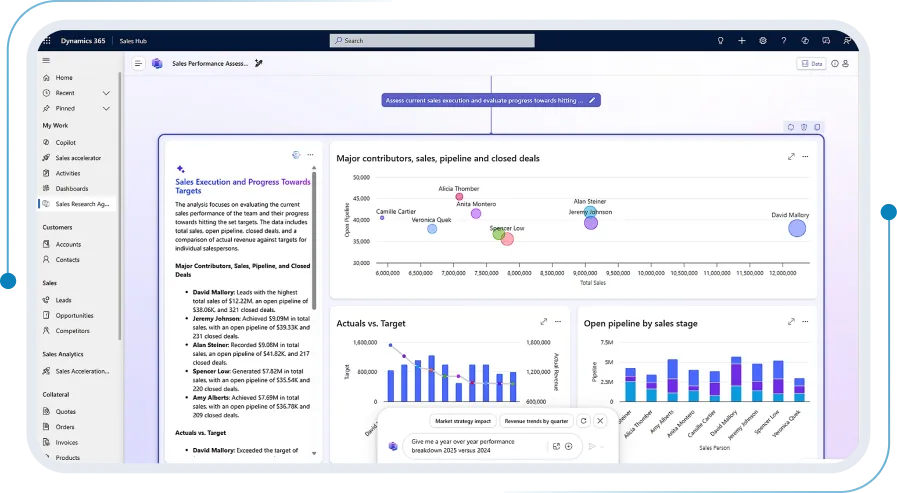
What is the Microsoft Dynamics 365 Sales CRM?
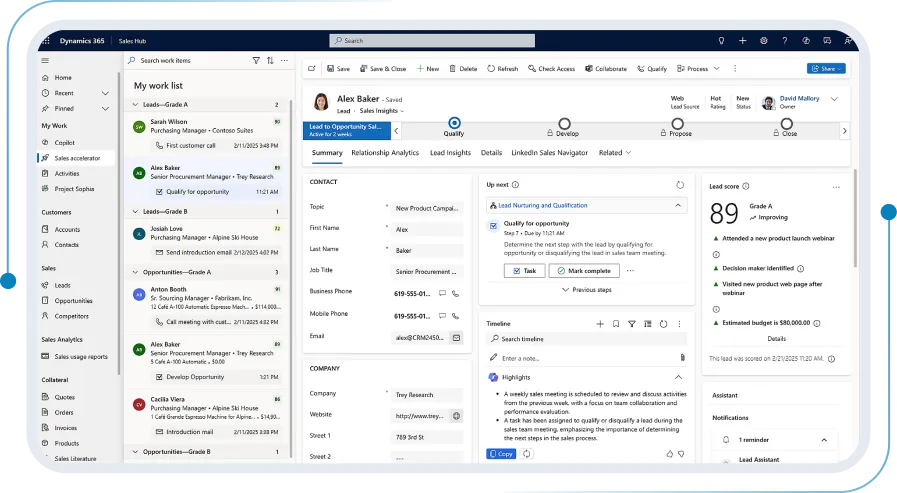
Dynamics 365 Sales CRM is a cloud-native, AI-driven sales platform designed to help organizations manage customer relationships, accelerate revenue growth, and improve sales team productivity.
As a modern sales pipeline management software, Dynamics 365 Sales helps organizations replace fragmented CRM tools and manual processes with an intelligent platform that delivers end-to-end visibility into the sales lifecycle.
How fragmented systems and poor visibility limit business performance
Many organizations struggle to achieve predictable revenue growth because their sales operations are supported by disconnected tools and outdated processes. Sales teams often rely on multiple systems for customer data, pipeline tracking, reporting, and communication, creating inefficiencies that slow down decision-making.
Common challenges include:

Disconnected CRM, marketing, and financial systems

Manual data entry and inconsistent customer records

Limited visibility into pipeline health and deal progress

Sales teams working in isolated departmental silos

Outdated reporting and delayed business insights
Without a platform that can integrate with other systems of record, leadership teams lack accurate, real-time visibility into revenue performance. Forecasts are often based on incomplete data, making it difficult to plan resources, adjust strategies, or identify emerging opportunities.
How Dynamics 365 Sales transforms business operations
Dynamics 365 Sales modernizes revenue operations by connecting data, processes, and people within a single platform. Instead of relying on disconnected CRM tools, organizations gain one intelligent system that delivers real-time visibility, automation, and AI-driven insights across the sales lifecycle.
Key transformation capabilities include:
Unified customer and opportunity data
A centralized source of truth ensures sales teams, leadership, and operations stakeholders work with consistent, real-time information across accounts, leads, and opportunities.
Automated sales processes
Built-in sales force automation tools streamline lead qualification, task management, follow-ups, and reporting. This reduces manual work and improves sales productivity.
Real-time sales analytics and forecasting
Advanced dashboards powered by Microsoft Power BI provide leadership with clear visibility into pipeline health, conversion rates, and revenue forecasts.
AI-powered sales assistance
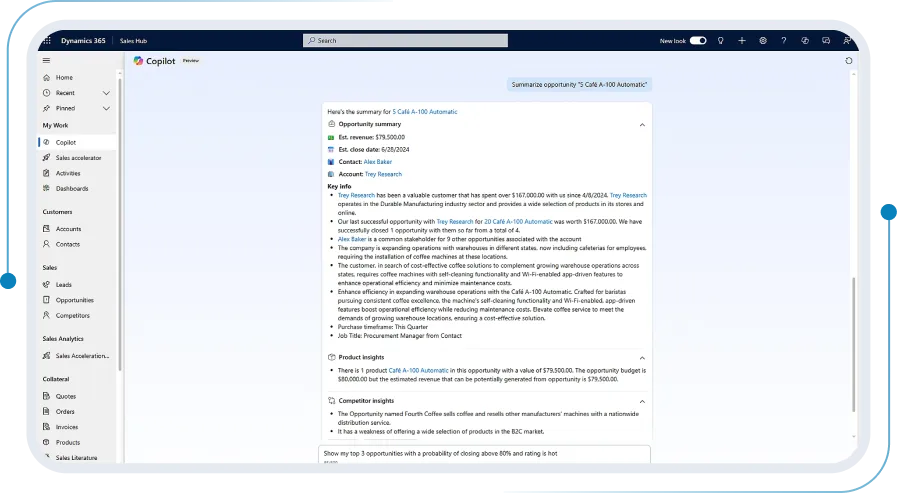
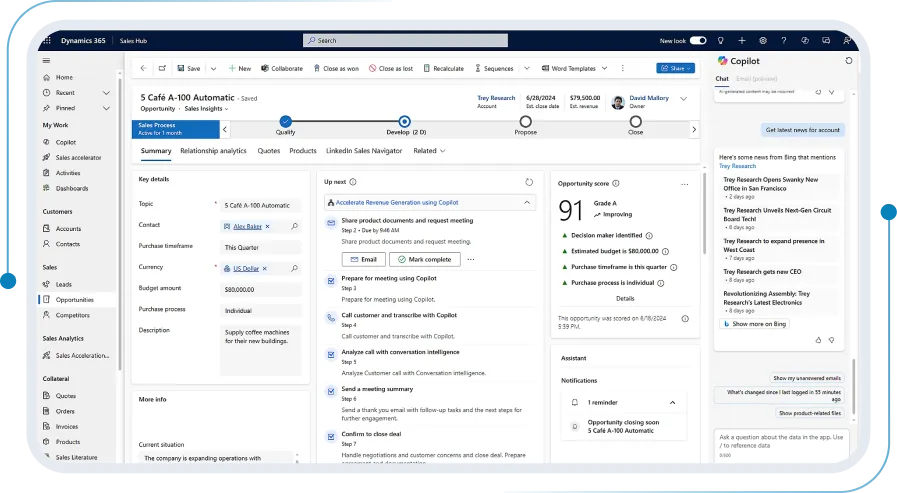
Microsoft Copilot analyzes customer interactions and sales activities to recommend next best actions, generate communications, and help sales teams focus on high-value opportunities.
Enterprise-grade cloud scalability
Microsoft Azure delivers secure, scalable infrastructure that supports global sales operations while ensuring governance, compliance, and high availability.
Low-code automation and extensibility
With Microsoft Power Platform, organizations can automate workflows, integrate systems, and extend Dynamics 365 Sales CRM capabilities without complex development.
Together, these capabilities transform traditional CRM environments into a modern sales pipeline management software that drives faster decision-making, improved forecasting accuracy, and scalable revenue growth.
Key capabilities and outcomes to expect with Dynamics 365 Sales
Sales pipeline management
Capabilities:
Dynamics 365 Sales provides comprehensive tools for managing opportunities across the entire pipeline. Sales leaders gain visibility into every stage of the sales process, enabling more accurate forecasting and performance management.
Outcomes:
- Improved pipeline visibility across teams and regions
- Higher win rates through structured opportunity management
- More accurate revenue forecasting
- Faster deal progression through automated workflows
Sales force automation
Capabilities:
Built-in sales force automation tools streamline daily activities such as lead qualification, opportunity tracking, meeting scheduling, and follow-ups. Automated workflows reduce manual data entry and ensure consistent processes across the sales organization.
Outcomes:
- Increased productivity for sales representatives
- Reduced administrative workload
- Standardized sales processes across teams
- Faster response times for customer inquiries
Customer engagement and relationship management
Capabilities:
The platform consolidates customer data, communications, and engagement history into a single interface. Sales teams can easily track interactions, understand customer needs, and personalize communications.
Outcomes:
- Stronger customer relationships
- Improved account management and retention
- Better collaboration between sales and service teams
- More personalized customer experiences
AI insights and predictive analytics
Capabilities:
AI capabilities powered by Microsoft Copilot analyze historical data and sales activities to generate predictive insights. These insights help sales leaders identify trends, prioritize opportunities, and forecast future performance.
Outcomes:
- Data-driven sales strategies
- Improved forecasting accuracy
- Identification of high-value opportunities
- Proactive risk management within the pipeline
Customer journey intelligence
Capabilities:
Dynamics 365 Sales integrates with marketing and service systems to provide a full view of the customer journey, from initial engagement to long-term relationship management.
Outcomes:
- Better alignment between marketing and sales
- Improved lead conversion rates
- Consistent customer experiences across channels
- Enhanced cross-sell and upsell opportunities
Advanced reporting and analytics
Capabilities:
Through integration with Microsoft Power BI, organizations can create interactive dashboards and advanced analytics models that provide deeper insights into sales performance.
Outcomes:
- Real-time visibility into sales metrics
- Faster executive decision making
- Enhanced strategic planning capabilities
- Improved accountability across the sales organization
Modules or core components within Dynamics 365 Sales
Dynamics 365 Sales includes several integrated components designed to support streamlined sales operations and enterprise visibility.

Lead and opportunity management
Track, qualify, and convert leads into opportunities with structured processes that improve pipeline visibility and forecasting accuracy.

Account and contact management
Maintain comprehensive customer profiles that capture interactions, communication history, and engagement activities.

Activity and task management
Automate scheduling, reminders, and follow-ups to ensure timely communication with prospects and customers.

Sales forecasting
Use predictive analytics to generate accurate revenue forecasts and identify potential risks within the pipeline.

AI-driven
insights
Leverage AI to identify sales trends, prioritize opportunities, and recommend the next best actions for sales teams.

Integration with Microsoft 365
Connect CRM data with Outlook, Teams, and Excel to enable seamless collaboration across departments.

Workflow automation
Automate repetitive tasks and approval processes using Microsoft Power Platform.

Security and compliance framework
Enterprise-grade governance ensures secure data access, regulatory compliance, and role-based controls.
Together, these components create a connected sales platform that enables intelligent decision making and scalable growth.
Benefits of adopting Dynamics 365 Sales
Organizations implementing Dynamics 365 Sales CRM gain measurable improvements in sales productivity, revenue predictability, and operational efficiency.

Real-time sales visibility
A comprehensive view of pipeline performance, opportunities, and customer interactions across the organization

Sales productivity
Built-in sales force automation tools reduce manual tasks and streamline daily sales activities

Accurate revenue forecasting
AI-driven insights and predictive analytics improve pipeline forecasting and strategic planning

Scalable growth
Cloud architecture built on Microsoft Azure supports expanding sales teams and global operations

Connected collaboration
Seamless integration with Microsoft 365 enables better communication between sales, marketing, and service teams

Data governance and compliance
Centralized customer data ensures consistent processes and stronger regulatory compliance

Faster decision-making
Interactive dashboards and analytics provide leadership with actionable sales intelligence

Lower total cost of ownership
Consolidating fragmented CRM tools into a single sales pipeline management software reduces operational complexity and infrastructure costs
By consolidating sales processes within an intelligent CRM platform, organizations can shift from reactive sales management to a proactive, data-driven revenue strategy.
Licensing and cost overview of Microsoft Dynamics 365 Sales
The cost of implementing Dynamics 365 Sales varies depending on several factors, including:

Licensing model and user types

Number of sales representatives and administrators

Selected modules and advanced capabilities

Integration with existing enterprise systems

Implementation complexity and deployment scope
Most organizations begin with a solution assessment to determine the optimal configuration and licensing structure for their business needs.
A strategic assessment ensures that the platform is aligned with organizational goals, sales processes, and long-term digital transformation initiatives.
Why partner with sa.global?
Organizations choose sa.global as a trusted Dynamics 365 Sales partner to deliver Microsoft business applications because of its proven ability to drive enterprise transformation.
Accelerated Dynamics 365 Sales implementation frameworks that reduce deployment timelines.
Key advantages include:

Recognized Microsoft solutions partner with deep Dynamics expertise

Global delivery capability supporting multinational organizations

Extensive industry knowledge across professional services and technology sectors

Accelerated implementation frameworks that reduce deployment timelines

Outcome-driven methodology focused on measurable business value

24/7 managed services and ongoing platform optimization
With sa.global, organizations gain a strategic partner committed to delivering long-term success with Microsoft technologies.
FAQs
What is Dynamics 365 Sales CRM used for?
Dynamics 365 Sales CRM is used to manage the complete sales lifecycle from lead generation and opportunity tracking to deal closure and long-term customer relationship management. As a modern sales pipeline management software, it helps organizations centralize customer data, improve pipeline visibility, and enable sales teams with AI-driven insights that accelerate revenue growth.
How does Dynamics 365 Sales improve business operations?
Dynamics 365 Sales improves business operations by automating repetitive sales activities, providing real-time pipeline visibility, and delivering predictive analytics for more accurate forecasting. With built-in sales force automation tools, organizations can streamline workflows, reduce manual administrative work, and enable sales teams to focus on strategic customer engagement.
Is Dynamics 365 Sales suitable for mid-sized organizations?
Yes, Dynamics 365 Sales CRM is designed to support both mid-sized businesses and global enterprises. Its cloud-native architecture allows organizations to scale their sales pipeline management software capabilities as they grow, ensuring consistent processes, governance, and customer visibility across expanding sales teams.
How long does a Dynamics 365 Sales implementation take?
The timeline for a Dynamics 365 Sales implementation depends on factors such as the number of users, integration requirements, and customization needs. Many organizations can deploy core capabilities of Dynamics 365 Sales CRM within a few months, while more complex enterprise deployments may take longer to fully integrate advanced sales force automation tools and analytics.
Does Dynamics 365 Sales integrate with Microsoft tools?
Yes, Dynamics 365 Sales integrates seamlessly with the broader Microsoft ecosystem, including Microsoft 365, Microsoft Power BI, Microsoft Power Platform, and Microsoft Azure. These integrations enhance sales pipeline management software capabilities by enabling advanced reporting, workflow automation, and AI-powered productivity across the sales organization.
Can organizations migrate from legacy CRM systems to Dynamics 365 Sales?
Organizations can migrate from legacy CRM systems or outdated sales platforms to Dynamics 365 Sales CRM through structured data migration and integration frameworks. This transition allows businesses to replace fragmented systems with a unified platform that delivers modern sales force automation tools, advanced analytics, and scalable cloud infrastructure.
What support is available after implementation?
After deployment, organizations typically receive ongoing support that includes system monitoring, platform optimization, user training, and continuous improvement services. Managed service providers such as sa.global help ensure Dynamics 365 Sales CRM continues to deliver maximum value by evolving with changing business needs.
Can Dynamics 365 Sales support global sales teams?
Yes, Dynamics 365 Sales CRM is designed to support multinational sales operations with multi-region deployment, role-based access control, and scalable cloud infrastructure. This makes it an ideal sales pipeline management software for organizations managing distributed teams, complex territories, and global customer relationships.