What is Microsoft Dynamics 365 Supply Chain Management?

Microsoft Dynamics 365 Supply Chain Management is a cloud-native supply chain management solution that provides operational visibility, analytics, and workflow automation for procurement, production, inventory, and logistics.

The solution supports core business functions such as procurement, production, inventory management, demand forecasting, and logistics.

Microsoft Dynamics 365 Supply Chain Management

How fragmented systems and poor visibility limit business performance

Enterprises relying on disconnected systems and manual workflows often struggle with operational inefficiency and limited visibility. Siloed departments, outdated reporting tools, and fragmented data sources prevent real-time decision-making. These challenges not only constrain operational performance but also limit digital transformation initiatives. Without clear operational visibility into inventory, procurement, and logistics, businesses face:

Operational inefficiency

Redundant processes and slow response times

Missed revenue opportunities

Inability to optimize supply and demand

Compliance exposure

Risks due to inconsistent reporting and auditing

Poor forecasting

Reliance on historical data rather than predictive insights

Limited scalability

Difficulty adapting operations to market growth

Microsoft Dynamics 365 Supply Chain Management addresses these gaps with integrated planning, automation tools, and analytics that help operations teams monitor performance and make faster decisions.

How Microsoft Dynamics 365 Supply Chain Management transforms business operations

Microsoft Dynamics 365 Supply Chain Management transforms operations by connecting people, processes, and data across the enterprise. Key transformation areas include:

Key areas of Dynamics 365 Supply Chain Management transforms business operations

Visibility into operations

Centralizes information from procurement, production, inventory, and logistics to eliminate silos

Automation

Streamlines workflows, reduces manual intervention, and accelerates order-to-delivery cycles

Real-time reporting

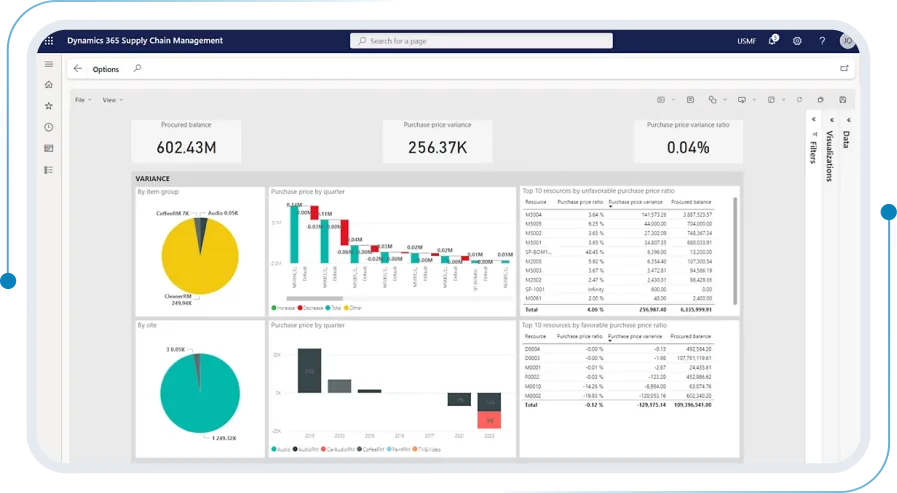
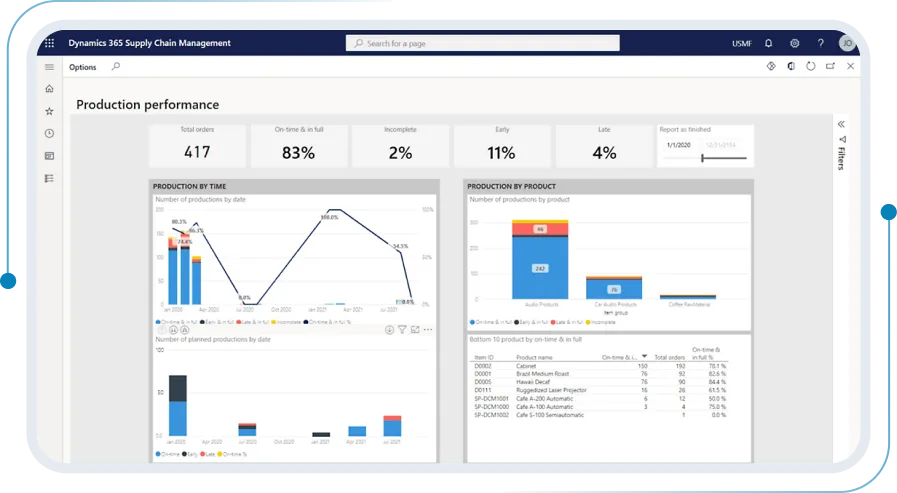
Provides instant insights through Microsoft Power BI, enabling better operational decisions

Predictive insights

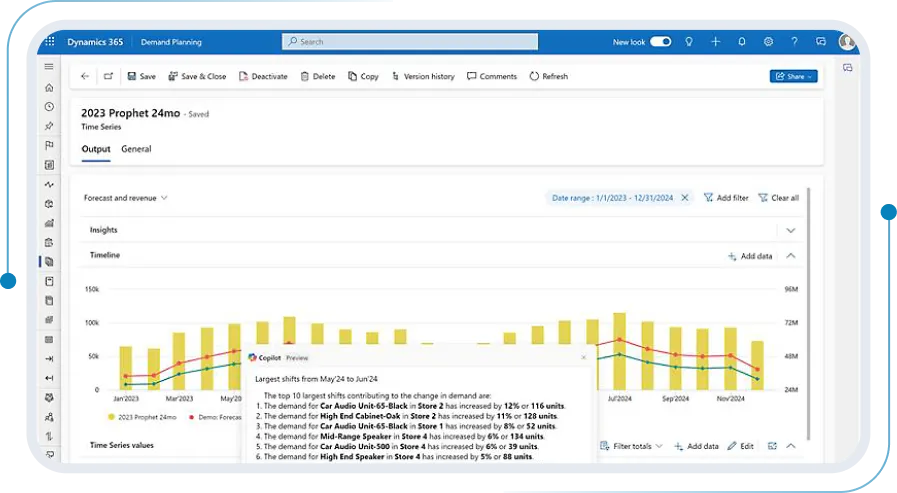
Uses AI-driven forecasting models to support demand planning and inventory optimization decisions.

AI assistance

Embedded Microsoft Copilot assists users by generating summaries, recommendations, and insights based on operational data.

Scalable cloud infrastructure

Built on Microsoft Azure, ensuring resilience, security, and enterprise-grade performance

By integrating seamlessly with the broader Microsoft ecosystem, including Power Platform for custom workflows and Microsoft 365 for collaboration, Microsoft Dynamics 365 Supply Chain Management enables organizations to operate with agility, efficiency, and confidence.

Key capabilities and outcomes to expect with Dynamics 365 Supply Chain Management

Enhanced operational agility and throughput

Capabilities:
AI-assisted demand planning, real-time production visibility, and dynamic schedule adjustment across manufacturing and distribution.

Outcomes:

  • Improved production responsiveness by enabling faster time-to-market and schedule adjustments.
  • Better alignment of supply and demand planning across operations.
  • Enhanced capability to handle market volatility through AI-informed decision support.

Reduced unplanned downtime and asset inefficiencies

Capabilities:

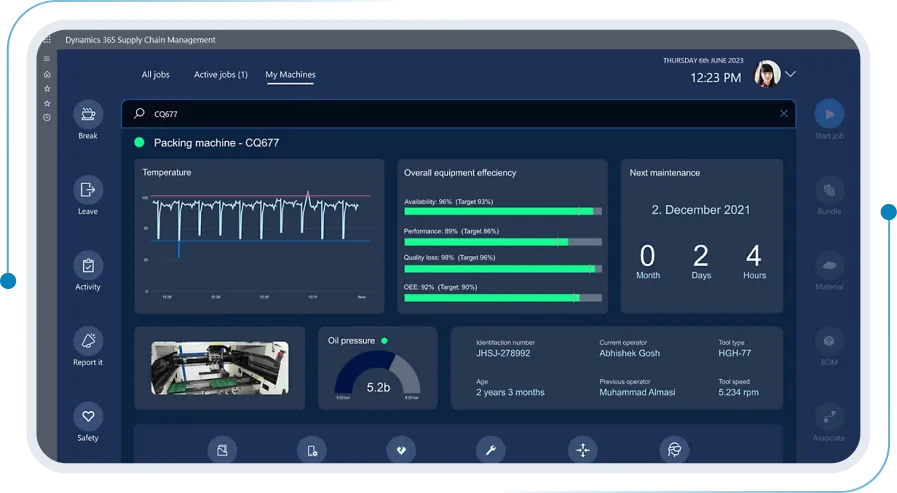
IoT-connected equipment monitoring, proactive maintenance triggers, and real-time machine utilization insights on Microsoft Azure.

Outcomes:

  • Less unplanned equipment downtime through predictive maintenance insights.
  • Higher overall equipment effectiveness (OEE) through continuous visibility and automated alerts.
  • Faster issue resolution and reduced production disruption.

Infrastructure cost reduction through cloud modernization

Capabilities:

Migrates legacy supply chain systems to Microsoft Dynamics 365 cloud services, reducing infrastructure dependencies while enabling flexible integration and extensibility.

Outcomes:

  • Lower infrastructure and system administration costs by retiring disparate on-premises solutions.
  • Reduced total cost of ownership (TCO) of supply chain IT landscape.
  • Streamlined technology stack enabling IT teams to focus on high-value initiatives.

Operational intelligence and AI-driven insights

Capabilities:

Unified real-time operational data across supply planning, inventory, sourcing, and logistics with AI analytics via Microsoft Power BI and Copilot.

Outcomes:

  • Increased visibility across the full supply chain through real-time dashboards and analytics.
  • Better forecast accuracy, enabling more proactive planning.
  • Reduced reliance on manual reporting and spreadsheet-based planning.

Improved product quality and supply chain responsiveness

Capabilities:

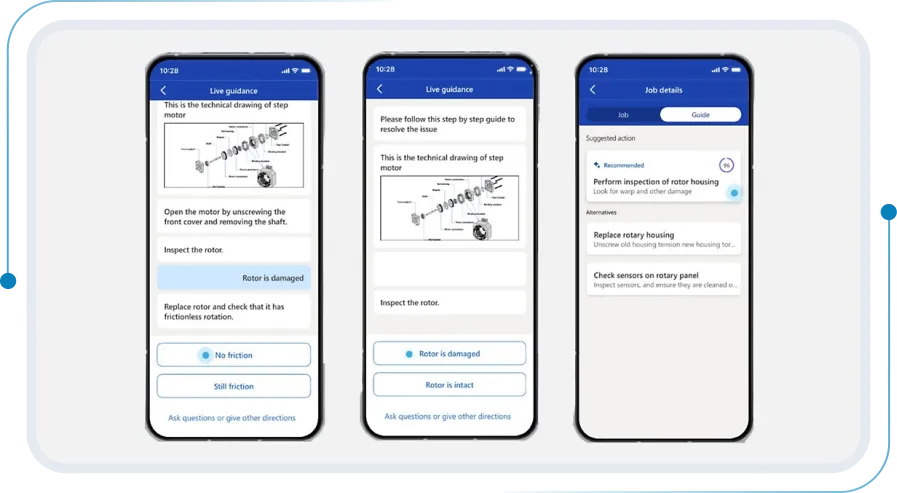
Real-time shop floor and quality data tracking, root cause analysis, and automated corrective workflows.

Outcomes:

  • Deeper insights into production quality and defect reduction.
  • Faster corrective action through visibility into root-cause variables.
  • Enhanced responsiveness to production variation and material quality issues.

Scalable and unified cloud supply chain platform

Capabilities:

Cloud-native architecture with modular extensibility, powered by Microsoft Azure and integrated with Microsoft 365 and Power Platform.

Outcomes:

  • Rapid scalability across global facilities and subsidiaries.
  • Faster adaptation to business growth and market shifts without costly hardware upgrades.
  • Enterprise-grade security, compliance, and reliability with 99.9% uptime.
Microsoft Dynamics 365 Supply Chain Management: Scalable and unified cloud supply chain platform

AI automation and workload efficiency

Capabilities:

Process automation tools help streamline repetitive tasks through workflow automation, alerts, and AI-assisted recommendations.

Outcomes:

  • Reduction in manual, repetitive tasks through automated workflows..
  • Enhanced planner productivity by reducing time spent on routine analytics and planning tasks.
  • Frees up staff to focus on strategic operational work.

Modules or core components within Microsoft Dynamics 365 Supply Chain Management

Inventory Management

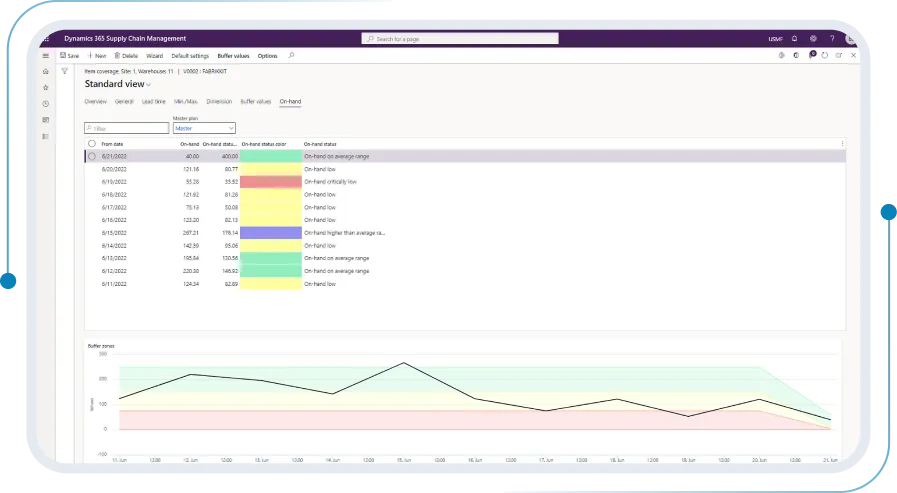
Provides real-time stock visibility, automated replenishment, and warehouse optimization

Production Control

Streamlines manufacturing operations and enhances throughput

Demand Forecasting

Predicts market demand using AI-driven algorithms for better planning

Procurement and Sourcing

Automates vendor management and purchase workflows

Transportation and Logistics

Optimizes shipping routes, reduces costs, and improves delivery accuracy

Quality Management

Ensures consistent standards across production and supplier networks

Warehouse Automation

Integrates robotics, IoT, and AI to streamline fulfilment

Supply Network Planning

Balances supply and demand across global operations

Each module contributes to unified operations, enhanced visibility, operational intelligence, and enterprise-scale automation.

Benefits of adopting Microsoft Dynamics 365 Supply Chain Management

Benefits of adopting Dynamics 365 Supply Chain Management

Real-time business visibility across operations

Faster, data-driven decision-making

Enhanced collaboration across departments and partners

Scalable cloud architecture for global operations

Stronger governance and compliance

Reduced total cost of ownership through process efficiency

Improved forecasting and demand planning accuracy

By leveraging Microsoft Dynamics 365 Supply Chain Management, organizations can achieve a measurable transformation in operational performance, responsiveness, and growth potential.

Client success stories with sa.global

Quant

Overview: Quant, a global industrial services provider, replaced legacy systems with Dynamics 365 Supply Chain Management (alongside Finance and Project Operations), achieving unified processes across 12+ countries.

Results:

  • Eliminated three third-party solutions using out-of-box functionality
  • Reduced manual payment processing by approximately 3 hours per week
  • Streamlined global operations with a unified chart of accountss

PT Belfoods

Overview: PT Belfoods Indonesia moved from Microsoft Dynamics AX 2012 to Dynamics 365 Finance and Dynamics 365 Supply Chain Management with sa.global’s support, enabling streamlined finance and operations and improved productivity.

Results:

  • Single source of truth for financial and operational processes
  • Improved efficiency and reduced process costs

Licensing and cost overview for Microsoft Dynamics 365 Supply Chain Management

Pricing for Microsoft Dynamics 365 Supply Chain Management varies depending on:

Licensing model (per user, per module, enterprise-wide)

User roles and permissions

Selected modules and features

Required integrations with Microsoft ecosystem tools

Deployment scope and scale

A personalized consultation and solution assessment are the first step to determine the optimal configuration for your organization.

Licensing and cost overview for Dynamics 365 Supply Chain Management
unnamed-file.png

I am happy because the implementation process went smoothly. This implementation marks the beginning of our company’s journey towards improvement. Unlike the previous AX implementation, where there were often limitations in the system and making us less flexible, now after upgrading our system to Dynamics 365 Finance & Supply Chain Management, we can do more depending on what we want to achieve.

After six months of the project running, I am quite comfortable with our current team. I would like to express my gratitude to the sa.global team and the Belfoods team who have been involved in this project. This can also serve as an example for other business units.

Soerjo Winarto,
Chief of Operations
Chillibreeze Belfoods Indonesia

unnamed-file.png

Our current ERP system needed to be upgraded in order to meet our operation’s requirements; so, we set out in search of a best-in-class application that would really enhance and improve our organization’s business processes.

After evaluating several ERP alternatives, we have selected Microsoft Dynamics 365 as a business process management software that will manage and integrate icddr,b’s financials, supply chain, operations, human resource activities, reporting, research, hospital, and laboratory effectively. We are confident that this software will empower icddr,b to be more efficient in future.

Thomas Liam Barry,
Director Finance and ERP Project Director
icddr,b

Why partner with sa.global?

Dynamics 365 Supply Chain Management partner

Recognized Microsoft solutions partner with global expertise

End-to-end delivery capability across multiple regions

Industry-specific experience for manufacturing, logistics, and retail

Accelerated implementation frameworks for rapid ROI

Outcome-driven methodology focused on measurable business impact

24/7 managed services and support for enterprise operations

FAQs

What is Microsoft Dynamics 365 Supply Chain Management used for?

Microsoft Dynamics 365 Supply Chain Management enables end-to-end supply chain management, including inventory, procurement, production, and logistics. As a modern cloud supply chain management solution, it connects operational data across the supply network to improve visibility and coordination.

Microsoft Dynamics 365 Supply Chain Management improves operations by unifying data, automating processes, providing real-time reporting, and delivering AI-driven insights. These capabilities support more efficient supply network planning and help organizations respond faster to changes in demand, inventory, and production.

Yes, Microsoft Dynamics 365 Supply Chain Management scales from mid-sized to large enterprises, adapting modules to operational complexity. Its cloud supply chain management architecture enables companies to expand capabilities as supply networks grow.

Implementation timelines vary depending on the scope of processes and integrations, but full-scale Microsoft Dynamics 365 Supply Chain Management deployments typically range from 12-24 weeks. Organizations often adopt a phased approach, prioritizing core supply network planning and operational workflows first.

Yes, Microsoft Dynamics 365 Supply Chain Management integrates with Azure, Power BI, Power Platform, Microsoft Copilot, and Microsoft 365. These integrations extend cloud supply chain management capabilities by enabling advanced analytics, automation, and collaboration across teams.

Yes, Microsoft Dynamics 365 Supply Chain Management supports phased migration from ERP and legacy supply chain systems. This approach helps organizations transition gradually to cloud supply chain management while minimizing operational disruption.

Post-implementation support for Microsoft Dynamics 365 Supply Chain Management includes managed services, system monitoring, and ongoing optimization. These services ensure the platform continues to evolve alongside business needs and changing supply network planning requirements.

Yes, Microsoft Dynamics 365 Supply Chain Management supports governance through role-based access, audit trails, and regulatory reporting functionality. These features help organizations maintain data integrity and compliance across complex cloud supply chain management environments.