How long does ERP implementation take for enterprises?

A Microsoft Dynamics 365 ERP implementation for large organizations is a structured transformation program that typically takes 9-20 months to modernize finance, operations, supply chain, and enterprise data management. sa.global helps enterprises plan and execute global ERP rollouts, balancing speed, governance, and long-term scalability.

Microsoft Dynamics 365 Business Central Implementation

Microsoft Dynamics 365 ERP rollout: understanding enterprise ERP implementation timelines

Large organizations often operate across multiple regions and business units. Global entities require multi-currency financial management, regional compliance frameworks, and complex accounting structures. Enterprise ERP deployments are complex programs that involve both technology and operational change. Several factors directly influence ERP implementation timelines.

Number of legal entities and operating countries

Each country requires its own chart of accounts, tax configuration, statutory reporting formats, and localization. A multi-country rollout becomes exponentially more complex with governance, compliance, testing, and cutover.

Applications in scope

The scope of the ERP program also significantly impacts the ERP implementation timeline. Enterprise implementations frequently include multiple applications for finance, supply chain management, and project operations. Expanding the scope across additional modules increases testing, configuration, and integration work.

Data migration from legacy systems

Enterprise organizations often migrate data from several legacy systems. When data is inconsistent or incomplete, additional preparation and reconciliation work is required before migration can occur.

Integration with existing systems

Enterprise ERP platforms must also integrate with the broader technology ecosystem. Systems such as CRM platforms, payroll applications, banking systems, and procurement platforms frequently connect with ERP. Each integration requires separate development, testing, and validation cycles.

Change management at scale

Organizational readiness has a measurable impact on ERP implementation timeline. Large ERP programs require collaboration between finance, operations, IT, and executive leadership. Organizations that invest in early change management and user readiness programs generally experience smoother implementations and faster adoption.

ERP implementation phases

A structured ERP implementation plan follows eight phases with defined governance gates and deliverables at each milestone.

sa.global’s delivery approach combines five pre-implementation success factors, a purpose-built ACCelerate toolset that shortens ERP implementation time, and a structured four-stage delivery flow aligned to Microsoft’s FastTrack for Dynamics 365 program.

Discovery: understand your business

Every Microsoft Dynamics 365 implementation begins with a virtual kick-off involving all stakeholders. Business processes are mapped to establish a clear implementation foundation. How long an ERP implementation takes depends heavily on how thoroughly this stage is completed.

Design: tailor modules, workflows, and data migration

Discovery insights are translated into standardized business processes, reports, integrations, data migration plans, and training frameworks. For global programs, country-specific tax, legal, and statutory configurations are layered in, while environments and data gaps are addressed early.

Testing: enhance functionality and performance

End-to-end process flows are tested across modules and integrated systems. sa.global’s test automation tools reduce manual cycles and improve issue detection accuracy.

Deployment: go-live support, training, and adoption

After go-live, sa.global provides structured stabilization support with dedicated consultants. The focus is ensuring teams adopt the system effectively and realize the full ROI of the Microsoft Dynamics ERP implementation.
Let’s talk about the ERP implementation timelines for your organization

Why choose sa.global as your Dynamics 365 implementations partner

Rolling out Microsoft Dynamics 365 across multiple countries requires technical implementation expertise, cultural understanding, local compliance knowledge, and strong governance – delivered simultaneously. At sa.global, we have the scale and presence to handle truly global Microsoft Dynamics ERP implementation programs.

As a 13-time member of Microsoft’s Inner Circle and an 11-time Microsoft Dynamics Partner of the Year, sa.global brings a level of platform depth and delivery confidence that comes from more than 30 years of focus on the Microsoft technology stack.

For enterprise Microsoft Dynamics 365 implementation programs, that means your delivery team has seen your complexity before: multi-entity financial structures, global tax compliance, large-scale data migrations, and the change management programs that determine whether adoption follows go-live.

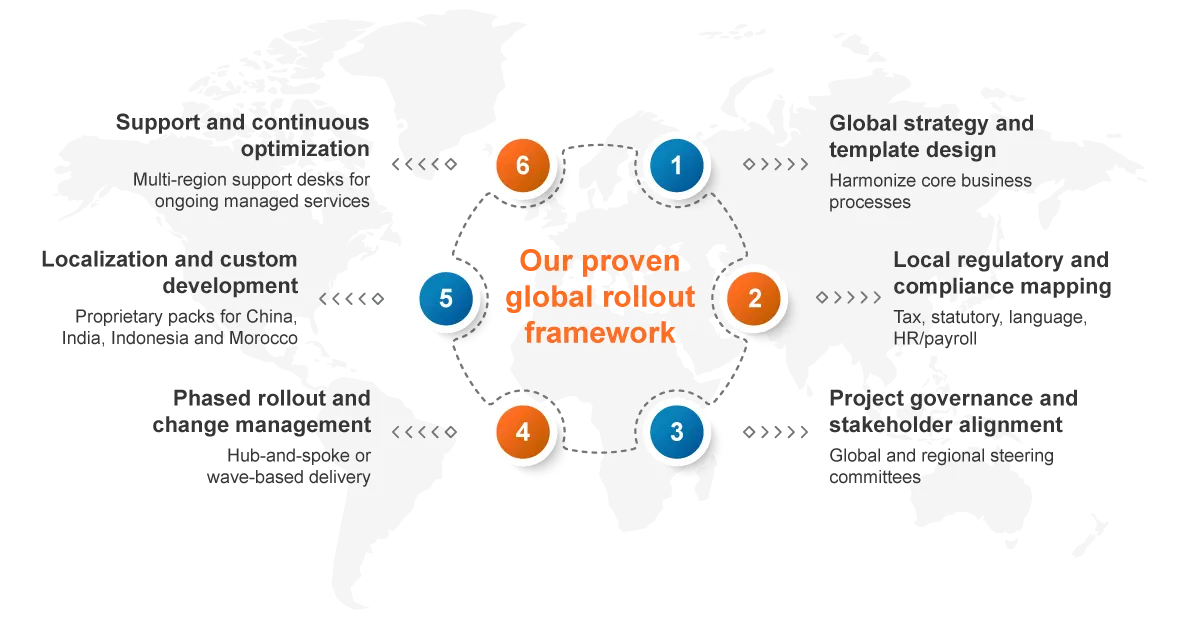
sa.global proven global rollout framework

Ready to plan your enterprise Dynamics 365 ERP implementation?

Our Dynamics 365 experts will work with you to assess ERP readiness, determine implementation scope, and plan global ERP deployments aligned with business strategy.

FAQs

How long does ERP implementation take for a multi-country organization?

For most large organizations, ERP implementation time ranges from approximately 9 to 20 months depending on project scope, number of entities, and global deployment requirements.

The primary factors affecting ERP implementation time include project scope, data migration complexity, system integrations, and organizational readiness.

Enterprise organizations operate with more complex processes, multiple legal entities, and larger integration environments. These factors increase the planning, testing, and rollout effort required for a successful implementation.

Yes. Many enterprises adopt phased rollouts where financial systems are deployed first, followed by additional operational capabilities. This approach reduces implementation risk and allows organizations to realize value earlier.